
Art to Go was a team of LA artists that made 12 x 12 inch paintings at public events in the 1990s. Organizer Gus Hudson got nerd character actor Bob Moss to shill in front of a table and hand out menus to potential customers. Subject choices offered “nudes and dudes,” styles included “my five year old could do that,” and among the mediums suggested was “flakey, stinky and dusty.” Patrons paid five dollars and were told to return in an hour. There was no pressure on the artists since the price was so low it really wasn’t even a transaction, but I joined in because the combined selections were so ridiculous. If clients didn’t like the result, Gus would offer another piece because we worked the whole time, orders or not. Some people stuck around to watch us, probably because they found artists painting more dramatic than some guy making their hot dog on a stick.
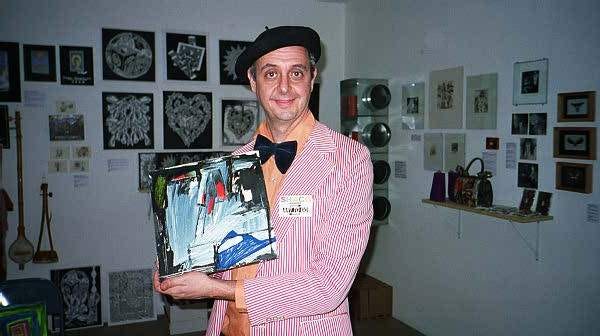
The Lowbrow irreverence of Art to Go was shared by a larger collective of culture jammers called the Los Angeles Cacophony Society. Started in 1991 by Al Guerrero and Reverend Al Ridenour, their pranks included Situationist hoaxes such as putting cement-filled plushie “Concrete Cuddlers” on toy store shelves and weird happenings like Pet Cemetery Bingo. Other Cacophony Society events included visits to off-the-radar places. At the Banana Museum in Monrovia, I posted a sign in the bathroom reading “Do Not Flush, Rare Albino Turd” over a peeled banana left floating in the open toilet.
One of the more spectacular Cacophony Society episodes involved the Saturday night exhumation of Bubbles the Stripper’s “corpse.” Bubbles’ disinterring required its burial on Friday, a process witnessed by Reverend Al’s neighbors. The night of the event, I was volunteered to help dig up the body and its rubber skeleton was later raped by Crimebo the Clown. That was too much for the already traumatized locals and believing Satanic rituals were taking place, they called the cops. Busting into his house the next morning, the police became concerned with the bizarre nature of Reverend Al’s explanation and made him show them Bubbles’ shredded plastic remains before letting him go back to sleep.
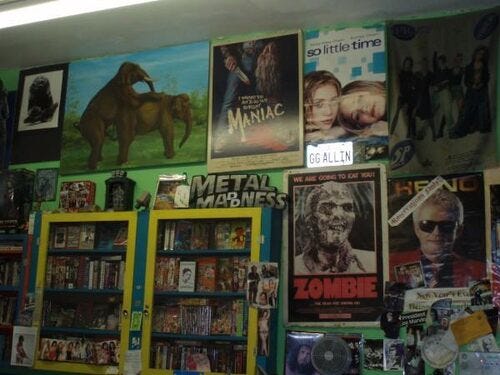
Cacophony Society happenings often took place at Mondo Video A-Go-Go, a video rental store on the Vermont Avenue strip specializing in demented films and documentaries. Presenting Lowbrow fare otherwise unavailable, owner Rob Schaffner categorized stock under headings like Doomsday Cinema, Delinquency, and Racial Hatred. Schaffner also hosted in-store performances by GG Allin, Mr. Outer Space, and Goddess Bunny, a porn star and transgender woman confined to a wheelchair after contracting polio. Although Gene Simmons of the band KISS was her biggest fan, Goddess Bunny represented everything appalling about Lowbrow and outraged businesses nearby forced Mondo Video to move. Rather than mellowing out in the new Melrose Avenue location, Mondo upped its sleaze quotient. Schaffner shot porn movies on location, and offered to pay for any perverted sex fantasy I had if he could film it.
Mondo also premiered movies in their parking lot and hosted Harrod Blank’s film Wild Wheels on art cars in 1993. Art cars are automobiles customized to present offbeat concepts, not indulge the traditional car fetishes of speed and sex appeal. Both approaches share the ultimate goal of a driving a unique vehicle, but kustoms are refined machines in comparison to most art cars. Blank’s movie featured cars and trucks that had undergone transformations to become covered wagons or huge pieces of fruit. As such, art cars were considered the weirdo fringe at most automobile shows and put near the portable toilets. Still, even lowriders considered a car covered with living ivy to be alright since it conformed to the basic rule that no matter what you’re driving, make sure it isn’t factory.
Art cars were part of The Blessing of the Cars, a semi-annual car show organized by Stephanie Council and Gabriel Baltierra. Inspired by the traditional Blessing of the Animals, their events featured Father Glenn Siquerias sprinkling holy water on pre-1968 classic cars, hot rods, and customs. Dressed in vestments adorned with hot rod flames, Siquerias’ consecration ensured that Divinity now protected the vehicle from disaster, something I can personally attest to as after its dousing of holy water, my 1957 Chevy Panel Truck only broke down in the driveway. Throughout the day, live music and strippers entertained those taking a break from the automotive assault and trophies were awarded onstage for the best hard luck story, bitchenest rides, and furthest distance driven to the show. Each year’s promo and merchandise designs were done by different Lowbrow artists including me, Amos, Dan Collins, Shag, and Andy Takakjian.
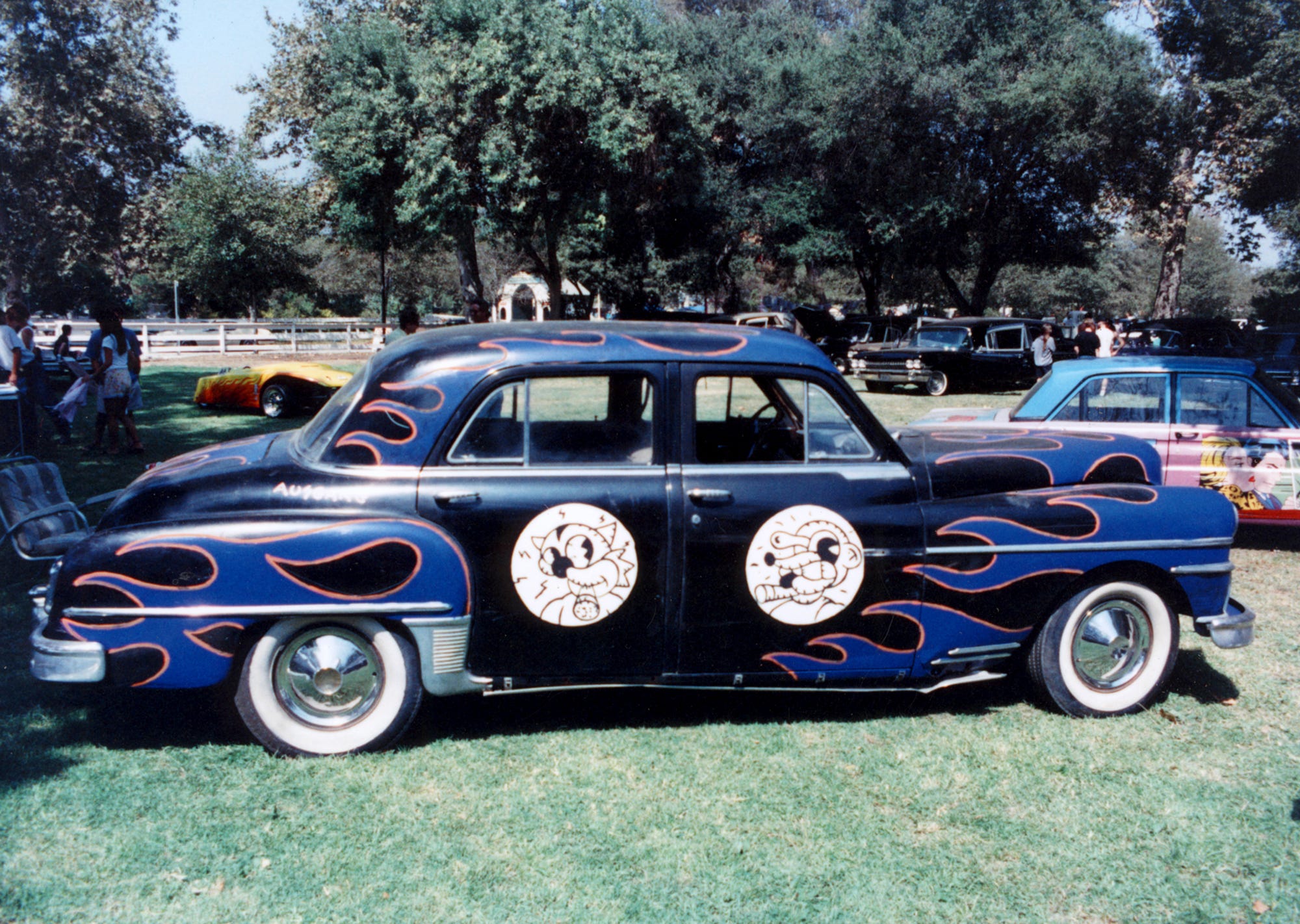
For the most part, The Blessing of the Cars was like any other professionally managed car show, but it became the most popular one in LA because Baltierra and Council added art to the pageantry. Each year they hosted a special Car Art Gallery tent that displayed pieces about custom cars and hot rods. The tent proved to be one of The Blessing of the Cars’ most popular attractions and people stood in line to look at work ranging from Keith Weesner’s flawless automotive paintings to kids’ amateurish tribute drawings. This inclusivity created an environment which demystified the art viewing experience for people not used to it and the informality extended beyond the art tent. The Blessing of the Cars believed even beat up rat rods and bad pinstriping were spectacular so when the extravagant duo Lux and Ivy of The Cramps showed up one year, they fit right in. For the 2003 Blessing of the Cars, I was asked to paint flames live on a 1949 Dodge from Memory Lane. It was sunny SoCal summer day, and the car had been unloaded in an open area with absolutely no shade. As I worked, my hand kept getting seared on the scorching metal and steam rose from the paint. Off in the distance Ed Roth was doing brisk business in his air conditioned merch tent and a few times I caught him watching me. When he took a break, Roth walked over just as I was crouched in a wheel well for shade. He stood there casting a welcome shadow and said,” Nice flames for a couple hours’ work,” then returned to his ringing cash register.
In addition to my agonized display, that year’s press release promised screenings of vintage Kustom Kulture and driver’s education movies. Unfortunately, that didn’t happen, but it was an interesting idea. Researching such things one night, I watched Kenneth Anger’s 1965 short film Kustom Kar Kommandos. Set to the song “Dream Lover” by The Paris Sisters, Anger’s film showed flagrantly gay young men erotically caressing an immaculate chopped and channeled 1931 Ford Coupe. Although inarguably a Kustom Kulture classic, Kustom Kar Kommandos was abhorred by many for its Queer attention to an object normally venerated by straight masculine culture. The transgressive nature of Anger’s film involved repulsion and softcore pornography, both elements essential to what the French-born Australian director Philippe Mora considered Lowbrow cinema.
I met Mora through Tequila Mockingbird after a private screening of The Beast Within, his 1982 movie featuring interspecies rape and its macabre result. As Mora later told me, The Beast Within used its gore to cloak a hidden subtext: the unwanted pregnancy and subsequent birth of a monster made his film “the first studio pro-choice movie.” As sardonic as that may seem, Mora’s 1973 film Swastika made no jokes in its exploration of Adolf Hitler and Eva Braun’s private lives. After sourcing the couple’s home movies, unseen since 1946, Mora’s film presented Hitler as a pet lover, vegetarian and non-smoking teetotaler. Although the movie also included the standard portrayal of der Führer as a psychopath, the screening of Swastika at Cannes resulted in fights and rioting in the theatre.
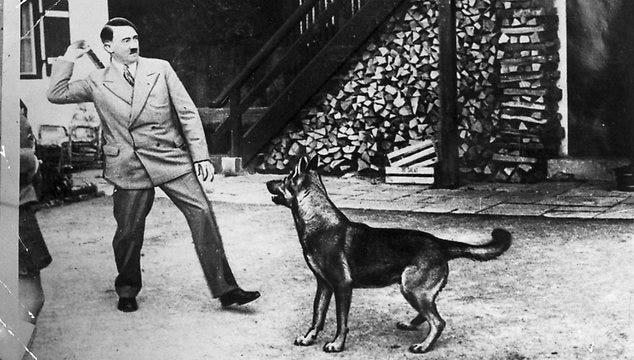
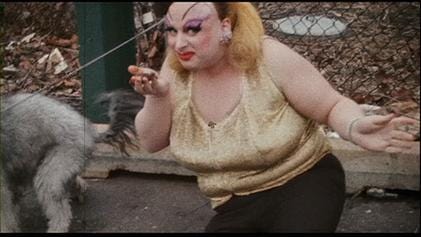
Film director John Waters may have brought Lowbrow to unsophisticated audiences that were better prepared, but Mora was out to educate, not just entertain. Ultimately though, it’s up to the viewer to decide what’s more spectacular: watching a reprehensible character play with their dog in Swastika or eat its shit in Pink Flamingos. Whatever the choice, both normalized the epically vilified, something very much in the Lowbrow vein.
I love this piece and it really makes me miss the days of yore: naughty, raw bloody, loud, in celebration of everything that was wrong. I went to a gun show in Portland many many years ago and saw a photograph of Hitler on a picnic eating a peach while paying with a Jack Russell terrier. I didn’t buy it and I’ve regretted the decision ever since.
Hey I think I know that guy from somewhere.